
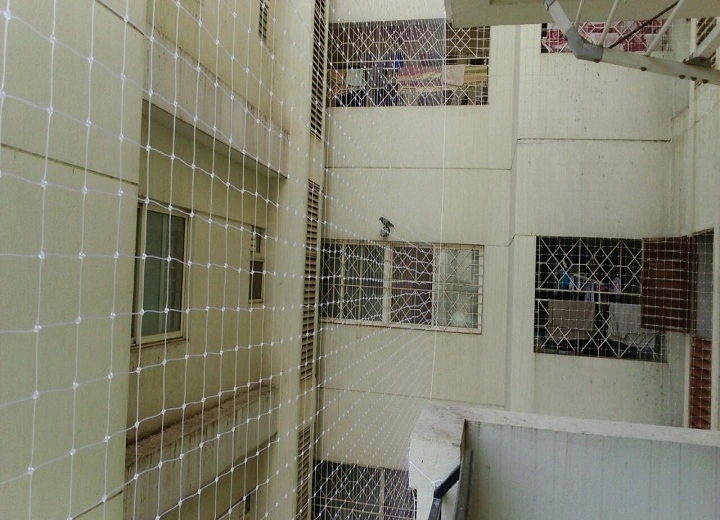
Service details kept from the older live page
Anti bird nets are practical for open spaces where birds enter regularly and leave droppings or nesting material.
Across Hyderabad, requests usually come from high-rise balconies, duct areas and flats facing open land or neighboring buildings. We plan the mesh line around the exact entry points.
Newer notes below add clearer measurements, price factors, photos to send and aftercare, while this section keeps the earlier wording that customers may already recognise.
Anti bird nets are used when birds regularly enter balconies, windows, ducts, shafts, terraces, utility areas or parking-facing openings and make the space difficult to keep clean. The problem may look simple at first: a few droppings, nesting material in one corner, feathers near the AC pipe or birds sitting on a ledge. But the useful solution depends on the actual entry route, not only the dirty spot.
In Hyderabad apartments, birds often enter through side gaps, pipe openings, duct faces, service shafts, balcony corners, window ledges and small spaces around grills. If only the front opening is covered while the side return stays open, birds can still enter. If a net blocks access to an AC unit or clothes line, daily use becomes irritating. A good anti bird net should close the real bird route while keeping light, air, cleaning and maintenance practical.
We plan anti bird net installation by looking at the full opening, side gaps, ledges, AC pipes, old nesting areas, fixing points and floor access. The finish should look neat from inside the home and should not make the balcony feel boxed in. When the net is tensioned correctly, the space stays open to light and air but birds cannot settle inside.
Where anti bird nets are commonly used
- Balconies with pigeon or bird entry from the front or side corners.
- Windows, utility windows and ledges where birds sit or nest.
- Duct areas, service shafts and narrow open building gaps.
- Open terraces, terrace corners and parapet-side entry points.
- AC outdoor-unit gaps, pipe routes and maintenance openings.
What we check before installation
The first check is where birds enter, not where the mess is visible. Droppings may collect near the balcony floor, but the birds may be entering from a side pipe gap or sitting on a ledge above the opening. Nesting material may be tucked behind an AC pipe or in a duct corner. For that reason, we ask for photos from inside the balcony and from both side angles.
We also check how the space is used. Some balconies have clothes hangers, flower pots, washing-machine pipes or AC access. Some windows need to open regularly. Some shafts need service access for plumbing or electrical work. The net plan should respect these uses instead of simply covering every visible gap without thought.
Why anti bird work is different from only cleaning
Cleaning removes the current mess, but it does not stop birds from returning. Anti bird netting is a preventive layer. It blocks entry before birds settle, nest or mark the place again. This is especially important in high-rise balconies and ducts where repeated cleaning is inconvenient and sometimes unsafe.
For spaces already affected by birds, old nesting material and heavy droppings should be cleared before the final fitting. If the net is installed over dirt and nesting waste, the area may still smell, attract insects or look unfinished. A clean base gives the installation a better result.
What makes the installation useful
- Bird entry points, side returns and ledges are checked together.
- The net keeps light and airflow while stopping regular bird movement.
- Windows, clothes lines, AC units and maintenance access remain usable.
- Old nesting areas are cleaned or planned before final fitting.
- The fixing line looks neat and does not leave loose corners.
Hyderabad areas we serve
We install anti bird nets across Hyderabad for apartments, villas, offices, schools, clinics and commercial buildings. Regular enquiries come from Kondapur, Kukatpally, Manikonda, Banjara Hills, Ameerpet, HITEC City, Jubilee Hills, Miyapur, Secunderabad, Madhapur, Gachibowli, Financial District, Nanakramguda, Kokapet, Narsingi, Raidurg, Tellapur, Nallagandla, Bachupally, Kompally, Begumpet and Somajiguda.
High-rise locations often need balcony, duct and side-return preparation. Older buildings may have ledges, open pipe routes and window corners where birds settle. Villas and independent houses may need terrace-side or utility-window areas served. The useful first detail is always the exact entry point: balcony corner, shaft opening, open terrace side, window ledge, AC pipe route or duct gap.


